Take holiday bookings on your own listings
Mark a listing as a holiday let, set its nightly prices and rules, and guests book it on propertylist.es: straight away by card, or as a request you accept. Payments go into your own Stripe account, and the calendar stays in step with Airbnb, Booking.com and Vrbo.
Create your free account See what it does
Long-term lettings run in the same module, free: tenancies, renewals and deposits. See the Rentals Module.
How it looks in the CRM
What you can do today
Everything on this list works in the CRM and on propertylist.es now.
Guests book and pay
Booked on propertylist.es
A holiday let marked for short-term rental shows a "Book this home" box on its listing page, with the price per night, the cleaning fee, the tourist tax and the total before the guest commits.
Instant book or request to book
With instant book, guests book free dates straight away and their card payment confirms the booking. With request to book, guests ask for their dates and you accept or decline within 24 hours. Or keep a listing on enquiries only.
Paid into your own Stripe account
Connect your agency's Stripe account and guests pay you directly by card: a share of the total to secure the dates, and the rest a set number of days before arrival. Late bookings are paid in full straight away. Without Stripe, guests can still send a request and you arrange payment with them.
Cancellation terms and refunds
Choose flexible, moderate, firm, strict or non-refundable terms, and add your house rules. Guests see both before they book. When a booking is cancelled, the refund due goes back to the guest's card.
Security deposit shown apart
A security deposit is shown beside the total as returned after the stay, and is not added to what the guest pays for the booking.
Your prices and rules
Prices that follow the calendar
Set a nightly price and a weekend price for the nights you choose, seasons with their own prices for summer or Christmas, and discounts for stays of a week or a month. Add a cleaning fee, an extra-guest fee above the guests included, and the tourist tax per adult per night.
Stay rules
Minimum and maximum nights, the days guests can arrive and leave, notice before arrival, how far ahead guests can book, the maximum number of guests, check-in and check-out times, and days kept free after each stay for cleaning.
Your calendar
Every holiday let on one calendar
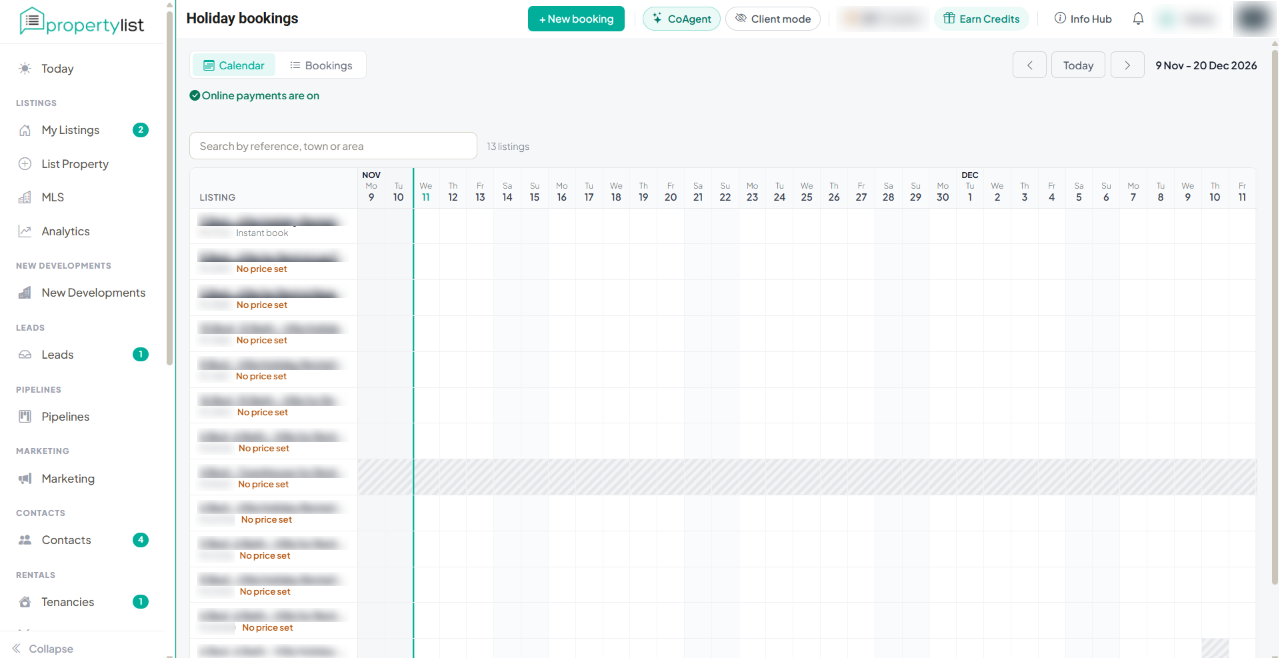
One calendar shows all your holiday lets side by side, and the bookings list splits upcoming stays, requests waiting for your answer, past stays and cancellations.
Calendar sync with Airbnb, Booking.com and Vrbo
Each holiday let has a calendar link to paste into Airbnb, Booking.com or Vrbo, and reads their calendars back, so the same nights are not booked twice. If a booking overlaps one on another channel, you are told.
Bookings you take yourself
Add a booking taken by phone or email and enter the total you agreed. The guest gets a confirmation email in their language with a link to their own booking page, where they can see it, pay and cancel. You can also send a payment link.
Guests and payments
Guests book with your agency, and card payments land in your own Stripe account. You decide the prices, the rules and the cancellation terms, and you can see every booking, upcoming and past, for each listing.
Already a member? Ask us to switch on holiday bookings for your agency, then mark a listing as available for short-term rental, set a nightly price and choose how guests book.
Still being built
Automatic guest registration with the police is not live yet.
Automatic guest registration with the police
A pre-arrival link where the guest photographs their ID and signs, with the report sent to SES.HOSPEDAJES on its own. Until it ships, nothing is sent to the police on your behalf: keep filing through SES.HOSPEDAJES, or your regional channel, yourself.
One module, mode per listing
A Costa del Sol property is often let long-term through the winter and by the week in summer. That is the normal pattern here, so holiday and long-term lets are not two products with two databases. Both run in the Rentals Module, and a listing becomes a holiday let when you mark it as available for short-term rental.
Long-term lettings keep their own tools: a tenants pipeline, renewal alerts, deposit tracking, and repairs the tenant starts and the landlord approves. See what is in it.
What the law asks of every holiday let
Five duties that apply whatever software you use. Three rest on settled law; the advert rule and the VAT change come from a decree-law in force since 8 October 2026 which the standing committee of Congress validated on 12 November 2026. The VAT change applies from 1 December 2026. Every one of these guides is free and public, and none of them needs a PropertyList account.
Guest registration, within 24 hours
Under the national procedure (Real Decreto 933/2021, art. 6), every holiday stay is reported to the police through SES.HOSPEDAJES twice, each time within 24 hours: at booking (or if it is cancelled) and when the stay starts. Establishments in Catalonia file through the Mossos d'Esquadra channel, and professional hosts in the Basque Country through the Ertzaintza channel; check your regional channel. Every traveller is included, children too; only those over 14 sign. Professional hosts keep the register for 3 years. Keeping no register or omitting a report is a serious offence, fined 601 to 30,000 euros; a late report, or errors or gaps in the register entries, is a minor one, 100 to 600 euros (Ley Orgánica 4/2015, arts. 36.20, 37.9 and 39).
Your registration code, in your adverts
Since 8 October 2026, Real Decreto-ley 29/2026 (art. 20.2.c) requires every rental advert to show the unit's identifying number or code where one exists; its preamble gives regional tourist-home codes as an example. The decree-law is in force, and the standing committee of Congress validated it on 12 November 2026. The separate national number of RD 1312/2024 is not a duty: in May and June 2026 the Supreme Court annulled the articles that created it.
Tourist registration in Andalucía
Before the first guest, the home is registered in the Registro de Turismo de Andalucía through a declaración responsable, a self-declaration filed online (Decreto 28/2016, art. 9, as rewritten by Decreto-ley 1/2025, final provision 6, in force 4 March 2025); from then on it can be advertised as a tourist home. These homes are now called viviendas de uso turístico, VUT, formerly VFT (Decreto 28/2016, additional provision 2, added by Decreto 31/2024). Adverts must show the registration number or code where one exists (Real Decreto-ley 29/2026, art. 20.2.c); the standing committee of Congress validated that decree-law on 12 November 2026.
Your community of owners
Since 3 April 2025 an owner who wants to start a tourist let needs the community's express approval, voted by three-fifths of the owners holding three-fifths of the shares (Ley de Propiedad Horizontal, arts. 7.3 and 17.12, as amended by Ley Orgánica 1/2025). Lets already running under the tourist rules before that date can carry on (LPH, additional provision 2).
VAT on short stays, from 1 December 2026
From 1 December 2026, in mainland Spain and the Balearic Islands, a furnished let is subject to VAT at the reduced 10% rate if the landlord provides hotel-type services (restaurant, cleaning, laundry or similar), or if it lasts 30 nights or less to the same tenant, unless, in that second case, the home is the landlord's habitual residence (Real Decreto-ley 29/2026, art. 7, amending Ley 37/1992, arts. 20 and 91). Before that date, a furnished let to guests is generally exempt unless hotel-type services are provided. The Canary Islands, Ceuta and Melilla are outside Spanish VAT and have their own taxes. The VAT is charged by whoever lets the home, normally the owner (Ley 37/1992, arts. 5 and 84). If your agency lets in its own name, it is treated as letting the home itself and charges the guest, and the owner's let to your agency can carry VAT too (art. 11). Ask your tax adviser how it applies to your lets, including stays paid before 1 December that take place after it.
Checked against the BOE, the BOJA and the Catalan and Basque government pages on 26 and 27 October 2026; the status of RDL 29/2026 checked against the BOE on 15 November 2026 (validation: BOE-A-2026-23755). Primary sources: RD 933/2021, LO 4/2015, RDL 29/2026, LAU, Decreto 31/2024, Decreto-ley 1/2025, Ley de Propiedad Horizontal, RD 1312/2024 (annulled articles), Mossos d'Esquadra guest register (Orden IRP/418/2010, in Catalan), Ertzaintza guest register (Orden of 25 November 2022, in Spanish).
Start taking bookings
Create your free agency account, mark your holiday lets for short-term rental and set their prices. Connect Stripe when you want guests to pay by card.
Questions
Is it live?
Yes. Holiday bookings, nightly prices, card payments, cancellation terms and calendar sync work today. Automatic guest registration with the police is still being built.
What does it cost?
Enquiries about holiday lets from the portal are free. Any commission on online booking payments will be set out in our Terms and on the pricing page before it is charged.
Do I need a Stripe account?
For instant book and card payments, yes: your agency admin connects your agency's own Stripe account in the CRM. Without it, guests can send a request to book and you arrange payment with them.
Who holds the guest's money?
Your agency. Card payments go straight to your own Stripe account, and refunds go back to the guest from it. PropertyList does not hold guest money.
Does PropertyList send anything to the police?
Not yet. Nothing is submitted on your behalf today, so keep filing through SES.HOSPEDAJES, or your regional channel, yourself. Automatic submission is being built, and it is for holiday bookings only: a long-term tenancy will never trigger it.
Are holiday and long-term lets separate products?
No. Both run in the Rentals Module. Mark a listing as available for short-term rental and it appears under your holiday bookings, ready for prices and bookings. Long-term lets keep the tenants pipeline, renewal alerts and deposit tracking.
I let on a temporada contract. Which side am I on?
It depends on the purpose of the let and, since 8 October 2026, on its length too. For guest registration, a stay for tourism or leisure counts as a holiday let; a genuine temporary-housing contract, for work, study or treatment, is arguably outside it, and many operators file anyway to be safe. Under Real Decreto-ley 29/2026, a tourist let can last at most 31 days (LAU art. 5.e), and a temporary-housing contract must run for more than 31 days, as a rule no more than 12 months, and state its reason in the contract (LAU arts. 7.2 and 9 bis). The decree-law is in force, and the standing committee of Congress validated it on 12 November 2026. Contracts signed before 8 October 2026 keep their old rules until their agreed end date. Talk to us before you move a temporada book across.